

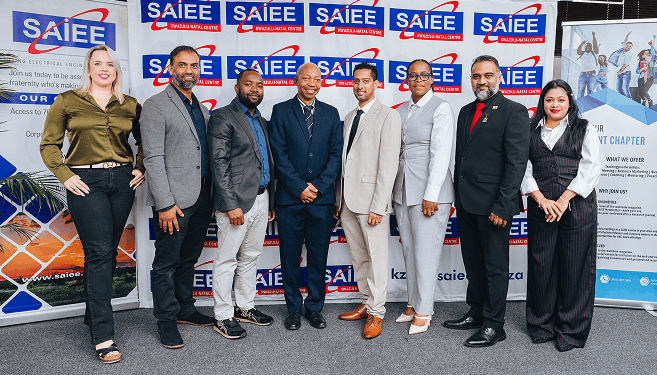
The South African Institute of Electrical Engineers (SAIEE) KwaZulu-Natal Centre hosted a successful technology conference at the University of KwaZulu-Natal’s (UKZN) Smart Grid Centre under the theme, Engineering 2.0: Advancing Engineering through Artificial Intelligence.
Hosted by the UKZN Centre for Power and Energy Systems, under the directorship of Professor Leigh Jarvis, the event brought together industry leaders, academics, engineers and students to explore the growing role of artificial intelligence (AI) in transforming the engineering profession and utility sector.
The conference was organised by Dr Mohamed Fayaz Khan, who was also officially inaugurated as the new Chairperson of the SAIEE KZN Centre for a two-year term. Khan has previously served as Honorary Vice-President of the SAIEE National Committee and continues to serve on the SAIEE National Council.
Khan said the conference highlighted the importance of collaboration between academia and industry in navigating the rapid evolution of engineering technologies.
“The conference created an important platform for engineers, researchers and industry leaders to engage on how AI is reshaping engineering practice and infrastructure development,” he said. “The discussions demonstrated that the future of engineering will rely on innovation, digital transformation and responsible implementation of AI technologies.”
Delivering the presidential address was newly elected SAIEE President Ms Prudence Madiba, who joined the conference remotely from The Netherlands. Madiba, who is also General Manager: Research and Strategy at Eskom Holdings, encouraged engineers to recognise the long-term impact of their work on society and future generations.
One of the highlights of the conference was a presentation by Mr Frans Shanyata, Senior Manager: Engineering Services at NamPower, who discussed driving utility resilience through digitalisation. Using the Sekelduin Substation as a case study, he demonstrated the real-world impact of digital transformation in utility infrastructure and the value of digital substations in improving operational resilience.
Mr Avarn Kooblal, Chief Engineer at eThekwini Municipality, shared insights on how AI could be used to modernise energy infrastructure and shift utilities from reactive to proactive operational models. His presentation explored predictive maintenance, smart metering and improved grid management through data-driven systems.
UKZN’s Professor Tahmid Quazi focused on bridging the gap between AI research and practical engineering systems that could be deployed in real-world environments. He highlighted the importance of ensuring that academic research is translated into technologies capable of addressing industry challenges.
The legal and ethical implications of AI were explored by labour law practitioner Ms Kirstin Hagglund of John Hagglund & Associates. Her presentation examined accountability when AI systems failed or produced incorrect outcomes, stressing that while AI could support decision-making, responsibility ultimately remained with the engineering professional signing off on projects.
The conference also attracted several industry leaders and stakeholders, including former SAIEE President and non-executive director of the Eskom Board, Professor Pat Naidoo, as well as representatives from organisations such as Eskom, eThekwini Municipality and Toyota.
Khan said the strong attendance and engagement reflected the engineering sector’s growing interest in AI and digital transformation.
“From predictive maintenance and smart grid planning to digital substations and renewable energy integration, the conference showcased how engineering is entering a new era driven by data and intelligent systems,” he said. “It is encouraging to see students, academics and industry professionals engaging so enthusiastically with these critical topics.”
He also acknowledged the contribution of the SAIEE KZN Committee, whose efforts ensured the smooth running of the conference, and thanked sponsors Aberdare Cables, ACTOM and Conlog for supporting the event and advancing engineering innovation.
The conference was registered with the Engineering Council of South Africa for Continuing Professional Development (CPD) accreditation, with delegates earning 0.5 CPD points for attendance.
Words: Sally Frost
Photograph: Sethu Dlamini