

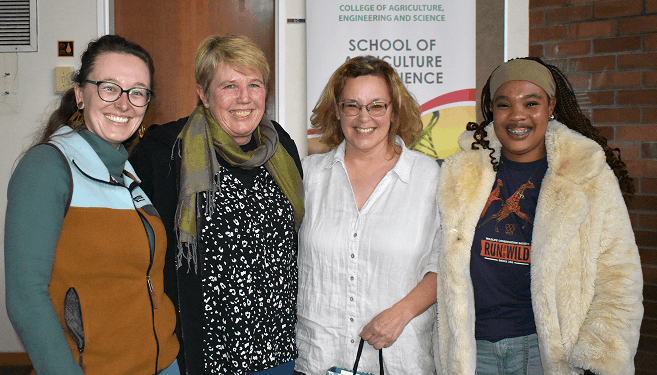
The School of Agriculture and Science at the University of KwaZulu-Natal (UKZN) in Pietermaritzburg hosted a screening of The Woman Who Loves Giraffes, a critically acclaimed 2018 documentary covering the life and work of Dr Anne Innis Dagg, the ‘Jane Goodall of giraffes’. The film highlights her contributions to understanding giraffe behaviour and ecology, work that continues through the Anne Innis Dagg Foundation.
The film covers Dagg’s unprecedented year-long solo journey to South Africa in 1956 to study wild giraffes. Despite facing several obstacles as a woman, she made pioneering observations of giraffe behaviour, diet and interactions with their habitat, laying the foundations for ongoing research into giraffe ecology. Her work, which included recording observations on 16mm film and in detailed journal entries and letters, earned her the distinction of being the world’s first ‘giraffologist’.
Dagg’s visit to South Africa in the 1950s included links to zoology at the then-University of Natal. She was hosted in Grahamstown (now Makhanda) by Professor Denis William “Jakes” Ewer and his wife Dr Rosalie F. “Griff” Ewer, whose academic careers in South African zoology began at the University of Natal. Their son, Dr Paddy Ewer, later became a much-loved member of staff.
Griff, an expert and pioneer in mammalian palaeontology, genetics, and behaviour, also defied the gender stereotypes of the time, wearing trousers and smoking a pipe. She was the first woman to receive the Zoological Society of Southern Africa’s (ZSSA) Gold Medal in 1975 and played a key role in enabling Dagg’s visit to South Africa, where Dagg collected her data.
Dagg published the foundational text on giraffes, The Giraffe: Its Biology, Behavior and Ecology, in 1976. In 2016, she received the International Giraffid Conference Lifetime Achievement Award, which was later named in her honour.
Dagg’s later career, after she returned to Canada, included completing her PhD, continuing to publish in behavioural biology and advocating for gender equality in academia.
The screening was attended by Dagg’s daughter, Ms Mary Dagg, who fielded questions from the audience of approximately 50 and spoke about her mother’s approach to raising her children, particularly a daughter, while advocating for gender equality, the work of the Anne Innis Dagg Foundation and Wild Tomorrow, educating young people about wildlife, and the passion of giraffe researchers.
“This film is not just about giraffes, but about my mom trying to kick down lots of doors as a woman in science,” said Dagg.
Encouraging students after the screening, Professor Colleen Downs said, “You might not end up in academia, but you might be able to change things, not only for [animals’] habitats, but for other young people that don’t have anyone to tell them about these things.”
Ms Scarlett Stromer and Ms Simangele Myeni, who conducted their master’s research on giraffe behaviour, with funding from the Anne Innis Dagg Foundation in partnership with Wild Tomorrow, attended the screening and presented Ms Mary Dagg with a token of the School’s appreciation. Their research at sites including Cumberland Nature Reserve and Fountainhill Estate is contributing to a greater understanding of giraffes and to conservation expertise in Africa.
Words and photographs: Christine Cuénod