

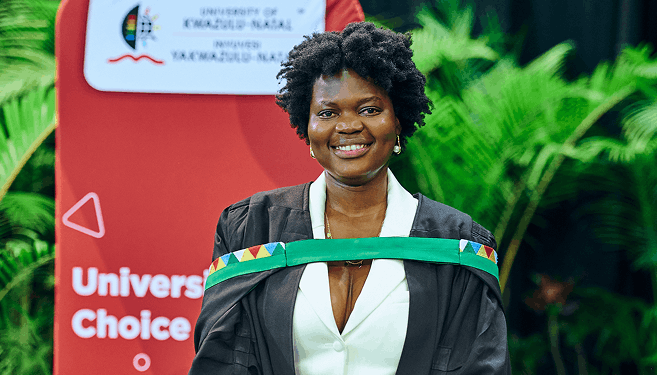
Ms Lindiswa Buthelezi’s master’s research in Ecological Sciences explored how cultural perceptions of owls shape their conservation, particularly in KwaZulu-Natal.
The study, titled: ‘Perceptions, Persistence and Ecosystem Services of Owl Species, especially in KwaZulu-Natal, South Africa’, provides insights that can help shape tailored conservation strategies.
Buthelezi left her home in Mtubatuba to attend the University of KwaZulu-Natal (UKZN), an institution revered at her school, allowing her to remain in the province while benefiting from the opportunities UKZN offered.
Initially, Buthelezi did not connect with her undergraduate studies in Biological Sciences, as she wanted to become a lawyer. However, working as a research assistant with Professor Colleen Downs at the end of her third year changed everything, and she began to see how her studies came together through data collection, analysis and manuscript development.
She subsequently pursued postgraduate studies in Ecological Sciences, earning her honours cum laude. Her passion for animal behaviour grew after a module taught by Dr Manqhai Kraai, whom she admires.
“Choosing Ecological Sciences was a chance event that led me to a career that has changed my outlook on life, kept my love for writing and reading alive, and combined them with my love for nature,” said Buthelezi.
Her master’s research examined global and local perceptions of owls, their dietary composition, and factors influencing the probability of detecting different owl species, including body size and activity patterns.
She found that negative perceptions of owls persist globally, with the birds often viewed as bad omens or messengers of death and illness, particularly among older or less-educated populations. Even in cultures where owls are revered as divine or associated with wealth, these perceptions can contribute to their slaughter or sacrifice during religious festivals. She also found that owl perceptions remain under-researched in many regions, although Africa has contributed significantly to the field.
While studying, Buthelezi worked as a laboratory demonstrator and supplemental instructor. She described completing her master’s degree as the most challenging experience of her life, but said it taught her perseverance, acceptance, positive thinking and grace.
Publishing two papers from her research was a particular source of pride.
Buthelezi plans to pursue a PhD, with the goal of becoming an accomplished lecturer.
She credited her mother, Ms Londiwe Lethukuthula Mlungwana, for supporting her dreams and demonstrating the value of hard work. She also expressed gratitude to Dr Mfundo Maseko for his guidance and compassion; Downs for her mentorship and commitment to research and students; her high school friend, Dr Nomasonto Masango, for inspiring her; and the Moses Kotane Research Institute and National Research Foundation for providing life-changing educational support.
Words: Christine Cuénod
Photograph: Sethu Dlamini