

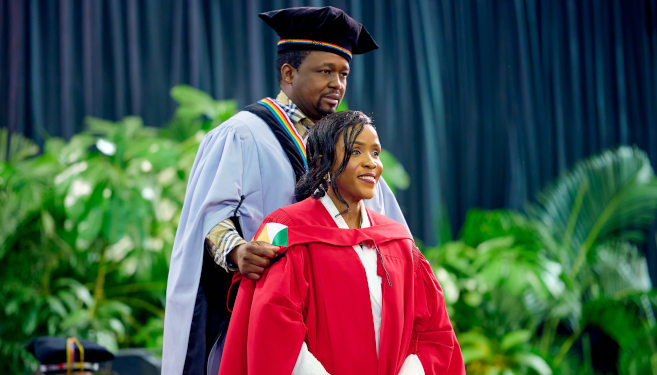
University of KwaZulu-Natal (UKZN) graduation attire is what first attracted Dr Sithembile Nkosi to the University; now she has followed up on her long-held admiration for the doctoral ‘red gown’ by qualifying from the Institution with a PhD in Biological Sciences.
While working full-time as a Mangosuthu University of Technology (MUT) lecturer, Nkosi studied for her PhD under the supervision of renowned cellular biologist Professor Yougasphree Naidoo, and the co-supervision of Professor Akash Anandraj (MUT) and Dr Sebataolo Rahlao (Oceanographic Research Institute).
“UKZN is a highly reputable institution with a strong track record in research excellence, particularly in the biological sciences,” said Nkosi. “As a full-time lecturer, proximity to my supervisor was key. It was important for me to be able to engage closely with Prof Naidoo, which greatly enhanced the quality of mentorship and academic support throughout my PhD journey.
“And on a lighter note, I have always admired the UKZN graduation attire; it became a small but meaningful personal motivation and symbol of the goal I was working towards!” she quipped.
Nkosi’s research, ‘An Integrated Genomics, Biogeographical, and Machine Learning Management Framework for Anredera Cordifolia (Ten.) Steenis in South African Biomes’, focused on understanding and managing A. cordifolia (Madeira vine), an invasive plant that threatens South Africa’s natural ecosystems.
“I used a combination of genetics, mapping and advanced computer models to study how this plant spreads and where it is most likely to invade next,” she explained.
“My aim was to help conservation practitioners identify high-risk areas early and apply more effective control strategies. Ultimately, this research supports the protection of biodiversity and helps preserve important ecosystems across the country.”
Nkosi was motivated by the need to develop research that is not only academically sound but also practical and useful for people working on the ground. She highlighted the urgency of the issue, noting that invasive species like Anredera cordifolia pose a serious threat to South Africa’s biodiversity.
“There is a need for tools that can assist land managers in protecting ecosystems and maintaining biome integrity,” she said. “I wanted my research to contribute directly to conservation efforts and decision-making.”
The significance of Nkosi’s research lies in its ability to bridge the gap between science and practical conservation. “The integration of genetics, spatial analysis and machine learning provides a more comprehensive understanding of how invasive species spread and how they can be managed more effectively,” she said. “The framework developed can be adapted for other invasive species, making it a valuable tool for long-term biodiversity conservation in South Africa and beyond.”
Nkosi credited her supervisor as vital to her success. “Prof Naidoo was crucial during the conceptualisation of the study and provided invaluable academic and financial support, including enabling data collection across all nine South African biomes,” she explained. She also thanked her family, including her mother, Ms Jane ‘maShenge’ Nkosi; her sisters, Mrs Nomthandazo Mafungwase Malwela, Mrs Landiwe Okwuteh, Ms Busisiwe Nkosi and Ms Nomfundo Nyembe; as well as her nieces and nephew for their unwavering encouragement and prayers. She further acknowledged the support of her students and her institution, MUT, which had been a constant source of motivation.
Looking ahead, Nkosi plans to build on her doctoral work, publishing her research and pursuing postdoctoral opportunities. She also hopes to use her experience to uplift others. “The lessons I have learned during my PhD journey will allow me to support and guide students better in developing their research skills and confidence,” she said.
“My PhD journey has been both challenging and rewarding, and reinforced my commitment to research that makes a meaningful impact,” she said. “I hope my work contributes to strengthening conservation efforts in South Africa and inspires students, especially those from underrepresented backgrounds, to pursue research and make a difference in their communities.”
Words: Sally Frost
Photograph: Sethu Dlamini