

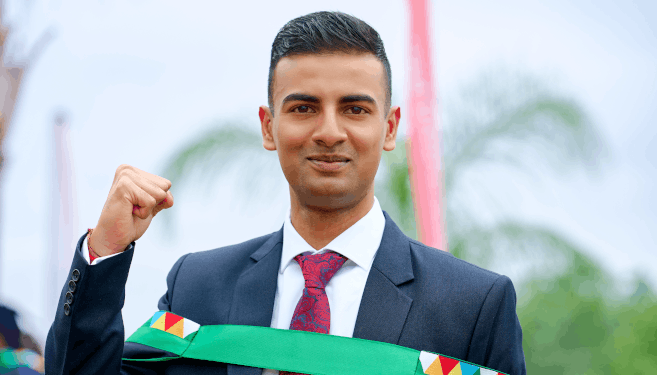
Mr Sharlan Moodley took on the challenge of building a model to predict ordered levels of academic performance for his Master of Science in Data Science qualification with the aim of producing a more nuanced understanding of academic performance… and scored a cum laude result for his efforts.
Originally from Durban and now working in Johannesburg as a data scientist at FNB South Africa, Moodley chose the University of KwaZulu-Natal (UKZN) for his undergraduate and honours studies in Statistics as it is one of South Africa’s leading universities. He was also attracted to its Data Science programme, which enabled him to develop the industry-relevant skills he sought.
“I enjoyed the balance between theory and practical work, which made the academic experience valuable,” said Moodley.
Supervised by Professor Mike Murray, in his thesis: ‘Evaluating Statistical and Machine Learning Techniques for Predicting Ordinal Student Academic Outcomes’, Moodley moved away from the simplification of academic outcomes into a pass-or-fail classification, which, in academic research, overlooks important differences in student achievement and recognised variations such as fail, pass and distinction to assess academic performance. He used statistical and machine learning techniques to predict students’ academic outcomes.
Moodley found that no single approach consistently outperformed other candidate models across all predicted outcomes. Instead, each model demonstrated strengths in forecasting specific levels of academic performance, highlighting the trade-offs inherent in different techniques.
Having to balance his studies with full-time work and travelling across provinces for assessments and examinations was challenging, requiring discipline, consistency, logistical planning, preparation, and an organised routine to stay on track academically.
“I believe resilience is an important trait when facing challenges in life. While we may not always be able to change our circumstances, we can always choose how we respond to them,” said Moodley.
He thanked his parents for their unwavering love and support, saying none of his achievements would have been possible without them. He also thanked Murray for his guidance and for helping him complete his research despite some challenges. He also thanked Dr Danielle Roberts, co-ordinator of the Data Science programme, for her direction and support.
Fascinated by data science and analytics due to their ability to transform raw data into meaningful narratives, Moodley is interested in uncovering insights that support data-driven decision-making, an increasingly relevant arena in a modern world where data is an essential asset. He is focusing on developing his academic career and applying his skills in an impactful way, remaining open to further study and academic advancement.
Words: Christine Cuénod
Photograph: Sethu Dlamini