

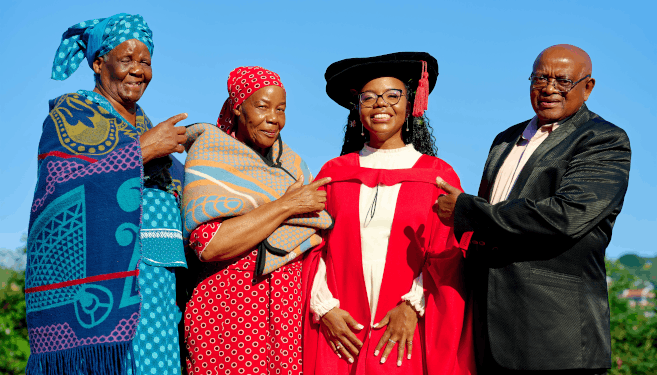
Dr Seipati Mokhosi’s path to earning her PhD in Biochemistry at the University of KwaZulu-Natal (UKZN) has been shaped by perseverance, passion and a desire to advance scientific knowledge in the field of brain and central nervous system (CNS) disorders.
Mokhosi built on years of academic and professional experience to produce research that contributes meaningfully to the emerging field of nanomedicine.
Her journey with UKZN began in 2009 as an undergraduate student. Reflecting on her academic trajectory, she credited her master’s supervisor, Professor Moganavelli (Mogie) Singh, with helping her envision a future in research. “Prof was instrumental in making me believe that it was possible for me to dream, and dream big,” she said.
Although she had long been interested in gene therapy for CNS disorders, practical responsibilities delayed her pursuit of a PhD. “With two kids and a household to run, I started working in industry after my MSc as I could not do full-time study,” she explained.
Her return to academia was made possible through the Accelerated Academic Development Programme (AADP), which allowed her to combine teaching and research. “This programme would allow me to teach – which I am passionate about – as well as conduct research,” she explained. Mokhosi joined UKZN as part of the programme in 2015, marking the start of her doctoral journey.
Her research focused on innovative therapeutic strategies for cancers associated with brain metastasis “I explored the use of magnetic nanoparticles for delivery of therapy in CNS disorders, and brain metastatic cancers – which include the primary lung cancer and the more aggressive triple-negative breast cancers and colon cancers,” she explained.
Mokhosi highlighted the clinical challenge posed by brain metastases, noting that “up to 50% of these patients will develop brain metastasis – which is where the cancer travels from the primary tumour site to the brain.
Central to her work was overcoming the blood-brain barrier (BBB), which often prevents effective treatment. “The challenge relates to poor prognosis, and the fact that any therapeutics targeted to the brain are hindered by the mechanistic and biological barrier provided by the BBB,” she said.
Her solution involved the design of magnetic ferrite nanoparticles: “These nanoparticles present the dual approach to explore their applicability to arrest the cancer at the primary tumour site (lung/breast) (using a magneto-targeting), with a possibility of further being able to traverse the brain for treatment,” she said.
Her thesis, titled: “The Design of Biocompatible Magnetic Ferrite Nanoparticles for Gene Delivery in Primary Cancers Associated with Brain Metastases”, made a novel contribution to the field.
Commenting on Mokhosi’s study, her supervisor, Singh, said: “Brain metastasis, a major clinical challenge, increases incidences of primary lung and breast cancers. This original study in nanomedicine is the first to design biocompatible magnetic ferrite nanoparticles for therapeutic interventions in brain metastasis with the additional goal of penetrating the blood-brain barrier using a peptide ligand.
“These ferrite nanoparticles exhibited exceptional biomedical properties and neuro-compatibility, providing an insightful strategy for further treatment efforts in primary cancers associated with brain metastasis.”
Mokhosi’s interest in CNS research was sparked decades earlier by the film Lorenzo’s Oil. “The parents (in the film) proceed to make important discoveries about this disease in the most unsuspecting ways – and their perseverance is quite inspirational,” she reflected, drawing parallels between the story and her own scientific journey.
She emphasised the broader significance of her work: “Given that 35-40% of triple-negative breast cancer patients end up with brain metastasis, the research findings have provided a way to approach it where we can potentially arrest the cancer before it reaches the brain. However, once in the brain, they have the potential to traverse the BBB for treatment.” She added that the field remains relatively new, saying she was “excited to be able to add value in that dialogue.”
Looking ahead, Mokhosi plans to deepen her expertise in neuroscience and expand interdisciplinary collaborations. To further this, she has enrolled in an international course, highlighting the importance of exploring cancer as a metabolic disorder and building networks in materials science.
She dedicated her achievement to her parents, children, friends, colleagues and mentors, who she described as “this amazing community of people that have ensured that I come out the other side alive.”
“This is not just any other career for me, it’s my life’s work,” said Mokhosi. “Maybe that’s why it took so long. But it was hard – really hard.”
Offering advice to others, she encouraged persistence and authenticity: “You have something unique to offer, and the world is waiting for your offering. You should remain authentic to yourself. Life is not a race or a sprint; keep calm and stay in your lane.”
Words: Sally Frost
Photograph: Sethu Dlamini