

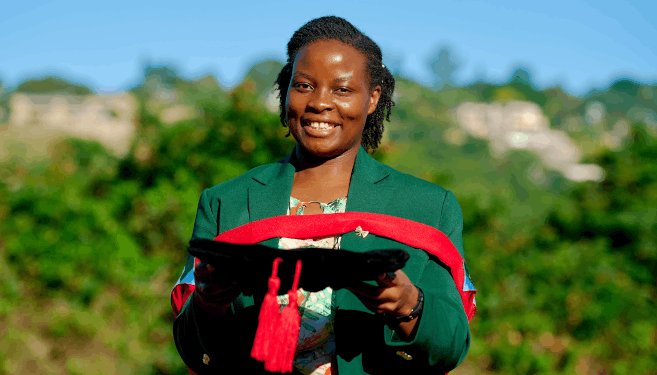
Kenyan scholar Dr Sarah Ogutu’s research examined how the body’s natural defence system responds to HIV infection and identified ways to predict HIV risk and strengthen prevention strategies.
Ogutu’s work secured her a PhD in Statistics specialising in Biostatistics from the University of KwaZulu-Natal (UKZN).
Supervised by Professor Henry Mwambi and Dr Mohanad Mohammed, Ogutu’s thesis: ‘Statistical and Machine Learning Approaches for the Analysis of High-dimensional HIV Data with Time Varying Covariates’, explored innovative ways of understanding complex biological data in the context of HIV.
“It was a pleasure to work with Sarah,” said Mwambi. “Her work hinged on leveraging both statistical and machine learning approaches to handle complex, high-dimensional longitudinal data with missingness. Her accomplishment is a manifestation of women in the forefront of science in Africa.”
Ogutu examined how the body’s natural defence system responds to HIV infection, focusing on cytokines (small proteins involved in immune responses). By analysing these patterns using advanced statistical methods, she identified ways to predict HIV risk and strengthen prevention strategies.
Her work provides practical insights to guide treatment planning and support public health efforts aimed at reducing HIV infections and improving survival, particularly in South Africa, where the burden remains high.
Ogutu’s decision to pursue her PhD at UKZN was shaped by the University’s strong reputation as a leading research-intensive university, ranked among the top institutions in South Africa and Africa. “Its emphasis on high-impact research aligned well with my academic goals,” she said.
She also noted the importance of institutional support, adding that the Postgraduate Tuition Fee Remission policy, which supports full-time doctoral students for the first three years, made it financially feasible to pursue her PhD.
Ogutu’s passion for biostatistics and HIV research is the result of a desire to make a meaningful difference. “My interest was driven by the urgent need to reduce the high burden of HIV, especially in Africa,” she said. “With millions of people living with HIV and significant numbers of new infections each year, particularly among women and girls, I was motivated to contribute research that informs more effective prevention and intervention strategies for affected communities.”
The significance of Ogutu’s research lies in its contribution to both methodological innovation and public health practice. “By integrating advanced statistical and machine learning approaches with complex biological data, my work supports more targeted and personalised HIV prevention strategies,” she said, noting that the work also contributed to improving treatment approaches and informing policy, supporting global efforts to end HIV/AIDS as a public health threat by 2030.
Her research output includes three published articles, with a fourth under review.
Ogutu is currently in a postdoctoral position funded jointly by two consortia: Data Science for Health Discovery and Innovation in Africa (DS-I Africa) and Sub-Saharan Africa Consortium for Advanced Biostatistics (SSACAB), whose focus is harnessing data science to solve global health issues and advanced biostatistics trading respectively. Looking ahead, she aims to establish herself as a researcher and academic in statistics and biostatistics at a research-intensive institution such as UKZN. She plans to continue focusing on methodological innovation, while also dedicating herself to teaching, mentoring students and contributing to curriculum development. “I also aim to foster interdisciplinary collaborations and strengthen data science and biostatistics capacity in Africa through training and mentorship initiatives,” she added.
She credited her success to the support system around her. “My supervisors played a critical role through their mentorship, guidance and belief in my potential,” she said. She thanked her family and acknowledged her parents and siblings. “Most importantly, I acknowledge my son, John Peters (7), whose sacrifice and understanding enabled me to fully dedicate myself to completing my PhD,” she added.
“This journey was not without personal challenges, and at times required significant resilience and determination to stay the course,” said Ogutu. “These experiences strengthened my commitment to completing the PhD and reinforced my belief that women in science often navigate complex circumstances yet continue to excel.
“I am grateful to UKZN’s College of Agriculture, Engineering and Science for the opportunity to pursue both my MSc and PhD in Statistics. The knowledge and skills I have gained will enable me to contribute meaningfully to research and capacity development in Africa and beyond.
“I am proud to be a UKZN alumnus.”
Words: Sally Frost
Photograph: Sethu Dlamini