

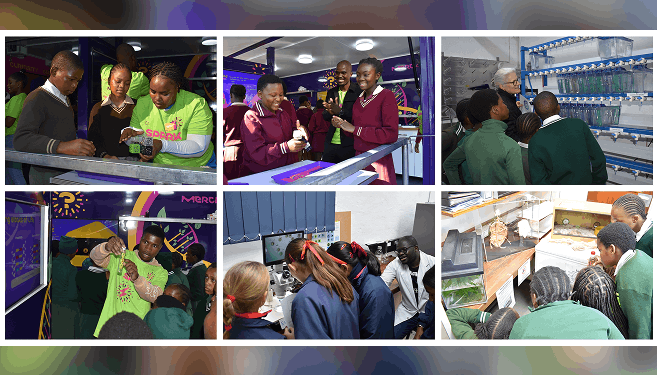
The University of KwaZulu-Natal (UKZN) hosted Merck’s Curiosity Cube on its Pietermaritzburg campus for the mobile science laboratory’s first visit to KwaZulu-Natal. Over six days, it welcomed more than 700 visitors, most of them primary school learners, who took part in hands-on science, technology, engineering and mathematics (STEM) activities.
Housed in a converted shipping container, the laboratory visits schools and university campuses in South Africa, Lesotho, Namibia, Botswana, Eswatini, Europe and North America giving learners opportunities to engage with science through practical experiments and develop their scientific curiosity. The Merck initiative encourages visitors to ask questions and explore the possibility of future careers in STEM.
The theme for 2026 was ‘Synthetic Biology’, and the Cube featured three experiments. These involved using lock and key models to learn how enzyme shapes influence biological processes, discovering how DNA codes affect traits and behaviours, and learning how scientists can switch genes on and off to engineer solutions to real-world challenges.
Learners from 12 schools across Pietermaritzburg visited the Cube, with the College of Agriculture, Engineering and Science providing transport support for underserved schools. An Open Day was also held on Saturday, 25 July, when members of the public could visit the Cube.
Learners benefited not only from Merck volunteers’ expertise as they carried out the experiments, but also engaged with UKZN’s postgraduate student volunteers from disciplines and sub-disciplines, including chemistry, biochemistry, microbiology, agricultural sciences, genetics, and ecology. School groups also visited UKZN facilities, including the Botany Gardens, Zebrafish Research Facility, Controlled Environment Facility, and Animal Physiology laboratory, to gain insight into the teaching, learning, and research that take place at the University.
“I will always remember this experience,” said Ms Azra Badat from Pelham Senior Primary.
“It has been a delight to host the Curiosity Cube at UKZN’s Pietermaritzburg agriculture campus,” said Merck co-ordinator Ms Adela Madaree. “The children left the Cube curious and inspired, and had a wholesome experience at UKZN’s facilities.”
Madaree thanked Professor Precious Mahlambi and Professor Matthew Akerman for supporting the initiative, taking the time to inspire children to pursue scientific careers and for arranging student volunteers.
Words and photographs: Christine Cuénod