

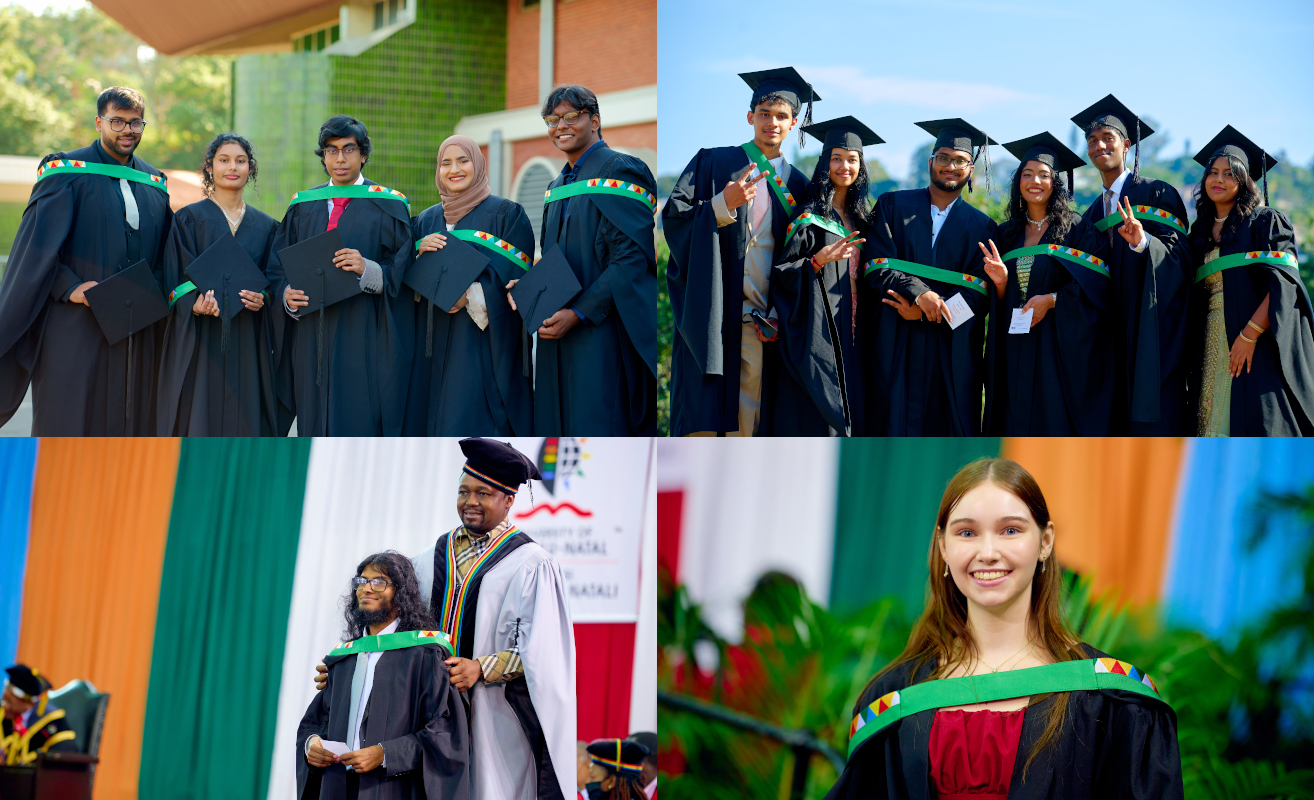
By far the greatest number of summa cum laude degree passes in UKZN’s College of Agriculture, Engineering and Science were achieved by graduates of the Bachelor of Science in Computer Science and Information Technology qualification – 13 in total.
They were: Mr Mahomed Akbur Ally, Mr Aveer Alamchand, Ms Rhea Boodhram, Ms Tiara Devanathan, Ms Caitlin Fogg, Mr Ethan Govender, Ms Shaista Naicker, Ms Naseeha Osman, Mr Arjun Ramphal, Mr Rahil Sha, Mr Sohil Singh, Ms Tarika Sukdeoa and Mr Mahir Syed.
To graduate summa cum laude, a student must complete the degree without failing any modules in the prescribed minimum time and obtain a credit-weighted average of at least 80% in those modules required for the qualification.
The degree is a three-year course offered in the School of Agriculture and Science at both the Pietermaritzburg and Westville campuses. The Computer Science component of the degree focuses on the theoretical foundations and development of computing systems, including software and algorithms, while the Information Technology (IT) modules focus on the practical application of computer systems and networks to meet the needs of businesses and organisations, including managing and maintaining those systems.
Building on this strong academic foundation, each of the 13 graduates brought their own story of curiosity, perseverance and passion for technology to their studies, with many already setting their sights on impactful careers in the rapidly evolving digital landscape.
For Syed, the decision to study at UKZN was both practical and personal, shaped by the Institution’s strong reputation and the example set by his family. He developed a keen interest in Artificial Intelligence (AI) and Natural Language Processing, describing these as “fields supported by a significant amount of mathematical and statistical theory”, which aligned closely with his strengths. Reflecting on his journey, Syed noted the importance of support structures, thanking his family, lecturers and peers, adding that their encouragement carried him “through every struggle” of his degree.
Sukdeoa’s journey was deeply rooted in a desire to honour the sacrifices of her family. She found inspiration in the power of machine learning, remarking that “it is truly incredible how AI applications have improved processes and been integrated into business workflows”. Sukdeoa also spoke candidly about the realities of university life, emphasising resilience: “There are times when you will fail, but that doesn’t mean the end of the road. You just have to take a different approach.”
Alamchand credited UKZN’s balance between theory and practical application as a key motivator in his success. He particularly enjoyed modules that involved building games, noting that while the process was demanding “the satisfaction of creating software products was worth it”. These experiences not only sharpened his technical ability but also strengthened his teamwork and communication skills – qualities he views as essential in the industry.
Also attracted to AI, Sha highlighted the importance of consistency over innate talent. Initially challenged by the transition to university, he reflected that “achieving summa cum laude was not about being the smartest in the room, but about staying committed to my goals”. His early exposure to coding and robotics laid the groundwork for a future he hopes will be centred on AI and machine learning innovation.
For Boodhram, a passion for problem-solving and analytical thinking underpinned her academic success. She particularly enjoyed modules such as Data Structures and Theory of Computation, which she said challenged her to think more deeply about efficient programming. Already making strides in industry, Boodhram has secured a position with a leading tech company following her participation in a competitive bootcamp, demonstrating the strong link between academic excellence and employability.
Ally found value in the practical application of his studies, especially during his capstone project, where he was able to develop solutions for a real-world client. His long-standing fascination with computers and game development evolved into a full-fledged career path, culminating in a position at Entelect, his ‘dream company’. He credited both financial support and mentorship at UKZN for laying the groundwork for his success.
Naicker’s academic journey was marked by exploration and self-discovery. Initially enrolled in Life and Earth Sciences, she later changed to Computer Science and IT, where she found her true academic home. “Sometimes you find your direction by elimination,” she reflected. Naicker was particularly drawn to the philosophical and practical dimensions of Artificial Intelligence, and emphasised that perseverance, rather than a straightforward path, defined her success: “Getting here wasn’t straightforward – but I kept going.”
Govender combined a passion for programming with a deep appreciation for the synergy between mathematics and computer science. His standout experiences included developing game-based projects and working on advanced AI models, which he described as making “the ‘under the hood’ mechanics of AI fascinating”. Govender credited a strong support network – from family and teachers to friends and mentors – as instrumental in his achievements, and encouraged future students to connect their academic work with their personal interests: “When you can link a complex module to something you are genuinely passionate about, the work starts feeling like a discovery,” he said.
Whether inspired by early encounters with coding, the influence of family, or the thrill of solving complex problems, these bright young minds have contributed to a collective achievement that underscores the strength of UKZN’s Computer Science and Information Technology programme.
Words: Sally Frost
Photographs: Sethu Dlamini