

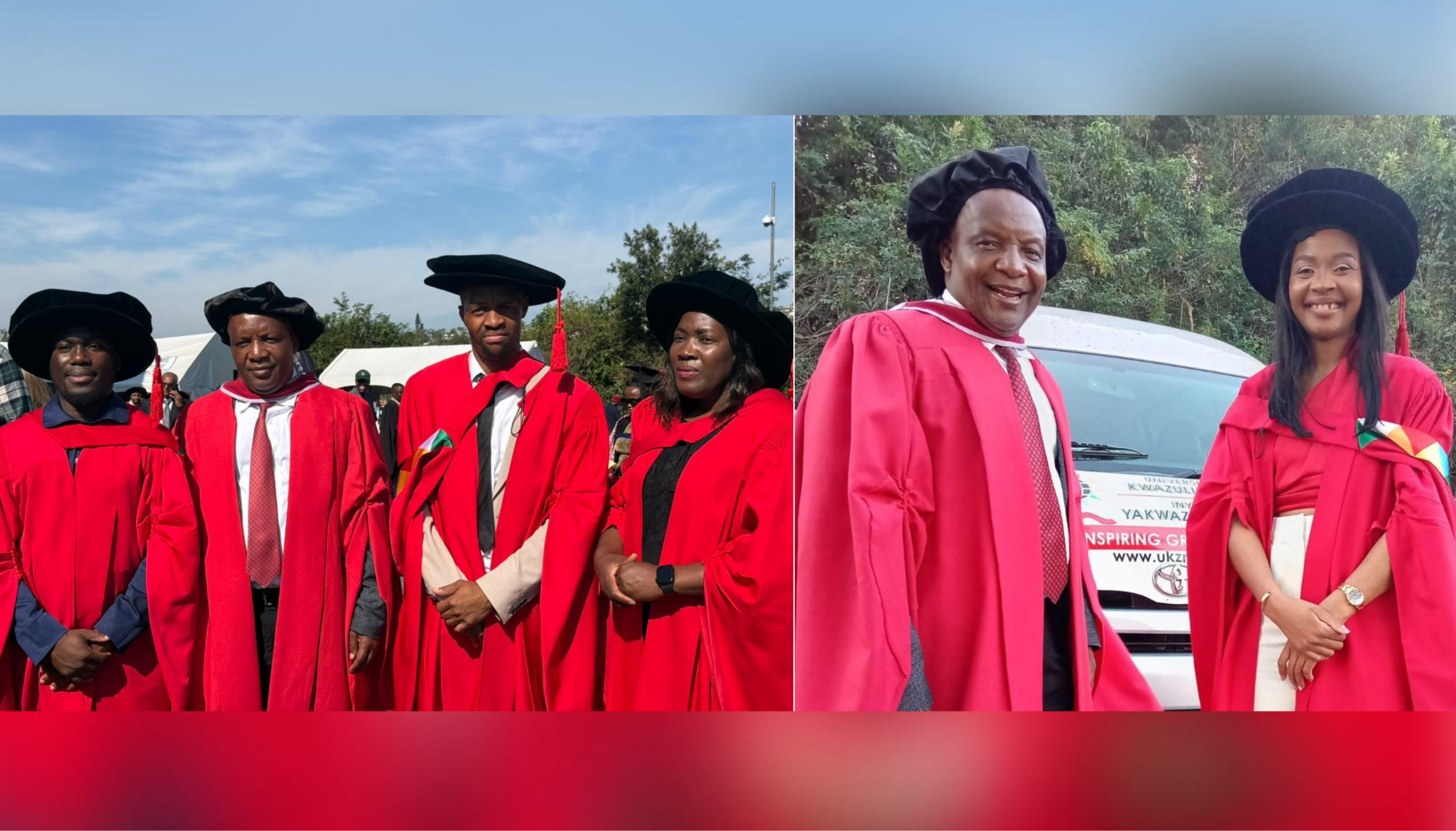
The sub-discipline of Soil Science in the Agricultural Science discipline in the School of Agriculture and Science is celebrating a high number of master’s and PhD graduates in the autumn graduation ceremonies, with their research underscoring the importance of soil science in addressing challenges linked to soil degradation, climate change, sustainable agricultural productivity and food security. Four graduates celebrated attaining their PhDs while working in research and academia.
Dr Grace Kanonge, a Chief Research Officer focusing on soil fertility and microbiology at the Soil Productivity Research Laboratory in Zimbabwe’s Chemistry and Soils Research Institute, characterised and evaluated naturally occurring soil microbes in Zimbabwe that can help unlock phosphorus in the soil, making it easier for cowpea plants to absorb important nutrients for improved growth. By combining these beneficial bacteria with natural rock phosphate fertiliser and helpful nitrogen-fixing microbes, the study found that crop growth and productivity could be improved, offering a more sustainable and potentially cheaper way to support farming. This study forms a first step of developing phosphorus based biofertilisers using locally adaptable microbes. Kanonge’s work was supervised by Professor Pardon Muchaonyerwa.
Dr Hlayisani Mabasa, a researcher at the Agricultural Research Council’s (ARC) Natural Resources and Engineering (NRE) division, was also supervised by Muchaonyerwa and the ARC’s Dr Adornis Nciizah. He explored farming methods to help sorghum crops grow better and keep sandy soils healthier in semi-arid areas under rainfed farming systems of South Africa. Mabasa found that reducing ploughing (no-tillage farming) helped in more water retention, improved soil health, and supported beneficial microbes, with the best approach depending on local climate and farming conditions and practices.
Dr Kaya Mrubata, also a researcher at the ARC’s Institute for Soil, Climate and Water, examined how different farming practices, such as planting dates, soil disturbance, and crop rotation, affect sorghum growth and soil health across semi-arid and subhumid parts of South Africa. He found that early planting, less ploughing, and crop rotation improved soil structure, but the benefits varied by region where drier areas saw greater gains in crop productivity, while wetter areas showed stronger improvements in soil health and beneficial microbes. His work was supervised by Muchaonyerwa and Nciizah.
Dr Samukelisiwe Vilakazi, a lecturer at the Cape Peninsula University of Technology, explored methods of nitrogen recovery from urine that transform it into a useful fertiliser, using materials made from pine bark and potato waste. She found that pine bark-based products, especially biochar, were particularly effective and could help spinach grow just as well as conventional chemical fertilisers, suggesting a more sustainable way to recycle nutrients and reduce waste. Her work was supervised by Muchaonyerwa and Professor Alfred Odindo.
Ms Samukelisiwe Ndlovu and Ms Sikhulile Gumbi graduated with their master’s degrees. Ndlovu’s work showed that co-composting cattle manure with crop residues improves nitrogen mineralisation and spinach productivity in acidic soils, supervised by Dr Nkosinomusa Dube and Muchaonyerwa. Gumbi, an agronomy intern at Corteva Agriscience, explored the storage of nitrogen from pig effluent on biochars from various feedstocks and the nitrogen fertiliser value of the products, and was supervised by Muchaonyerwa. In addition to these six postgraduate students, 12 students graduated with their Bachelor of Science (BSc) in Agriculture in Soil Science, and three graduated with a BSc in Soil Science, co-majoring with Hydrology.
These graduates’ success emphasises UKZN’s longstanding contribution, dating back to the University of Natal, to developing agricultural expertise that supports farmers, informs policy and advances scientific innovation in South Africa and beyond. This success story is testament to the contribution of collaboration between colleagues across institutions, and between colleagues in different sub-disciplines and within the discipline, that leveraged expertise and financial and infrastructural resources.
Words: Christine Cuénod
Photograph: Supplied